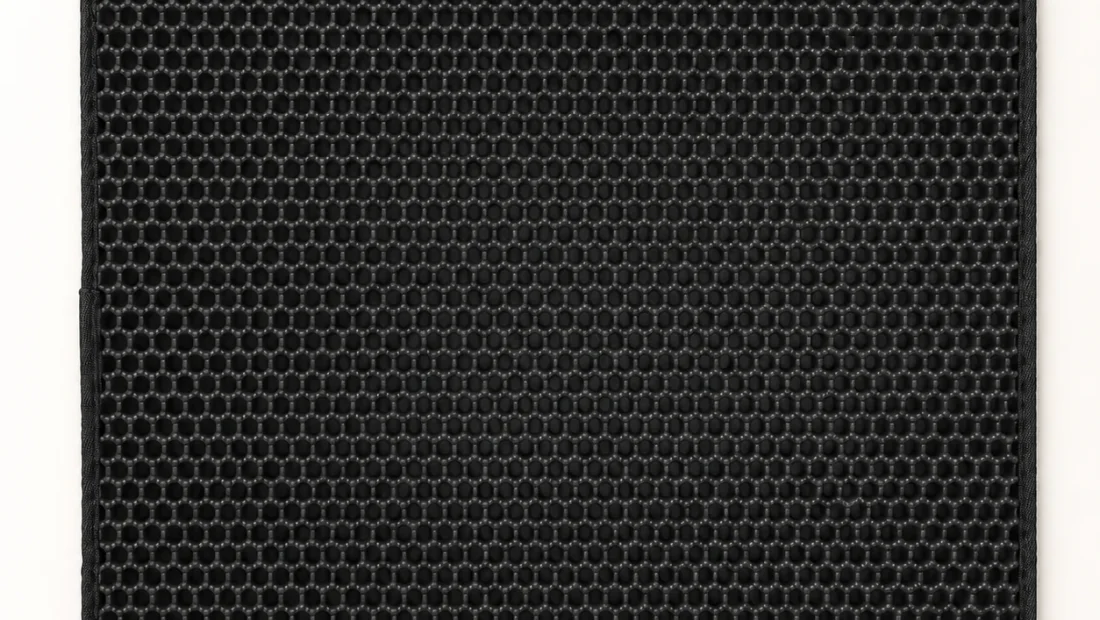
A litter mat gives loose granules somewhere to collect as your cat leaves the tray. The useful size depends on the exit route and available floor space, not just the overall size of the tray. A mat can help collect scattered litter, but it cannot guarantee a litter-free room.
Measure where your cat steps out
Note which opening your cat uses and where its first steps land. Measure that area with the tray in its normal position, leaving the entrance clear. Check doors, cupboards and walking routes before choosing a larger arrangement.
The compact double-layer litter mat is approximately 30 × 30 cm. Mark that footprint on the floor with a tape measure before ordering. It is a small landing area, so a cat that jumps over it may still carry granules beyond the mat.
One mat or several?
A single mat suits one compact exit zone. The three-pack of compact litter mats contains three mats of approximately 30 × 30 cm each, allowing separate placements or a wider arrangement. Three loose mats are not the same as one continuous mat: check that they lie flat without gaps or lifted edges in the walking path.
For a temporary travel setup, measure the available footprint around a foldable travel litter tray separately. Do not assume a travel tray and a mat share compatible dimensions because they appear in the same category.
Understand the double-layer design
The listed mats use a honeycomb surface over a lower layer. Loose granules pass into the space below so you can collect and empty them. Access for emptying matters as much as the top texture; make sure you can lift and open the mat without tipping the contents onto the surrounding floor.
A practical emptying and cleaning routine
- Lift the mat carefully and empty collected granules in accordance with the litter’s disposal instructions.
- Remove residue from the openings and between the layers rather than cleaning only the visible top.
- Follow the exact mat’s care instructions. The three-pack listing specifies warm water and mild detergent; do not assume strong cleaners or machine washing are suitable.
- Let every layer dry fully before placing it back on a dry floor.
- Check for curled edges, tears or damaged openings before reuse.
Keep the rest of the area manageable
A mat complements tray maintenance; it does not replace it. Keep a suitable litter scoop nearby and leave enough room to remove the mat without moving everything else. Avoid stacking loose accessories where they block the tray entrance.
Before you buy
Confirm the footprint, number of pieces, material and cleaning method on the individual product page. If your cat avoids the surface or routinely leaps over it, reconsider the layout rather than assuming a larger purchase will solve the problem.
Explore the pet cleaning collection or ask PawNest about a product measurement.